Home delivery, every day, from Tuesday to Saturday.

Freshly Cut &
Cool delivery
at home

When Should You Season a Steak? Before or After Cooking?

When Should You Season a Steak? Before or After Cooking?

The Truth Behind One of the Biggest Steak-Cooking Myths

"You should only season a steak after cooking, otherwise it will dry out."

It's a statement you've probably heard countless times. Maybe a friend told you, a chef mentioned it, or you came across it on social media.

But is it actually true?

The short answer is simple:

No. Salt does not dry out a steak.

In fact, many professional chefs deliberately salt their steaks well before cooking.

Here's why.


What Happens When You Salt a Steak?

When you sprinkle salt on a raw steak, you'll often notice small droplets of moisture appearing on the surface after a few minutes.

For many people, that's proof that salt pulls all the juices out of the meat.

But that's only part of the story.


Step 1: Salt Temporarily Draws Moisture to the Surface

Because the salt concentration is higher on the outside than inside the meat, a small amount of moisture temporarily moves to the surface.

This is a completely natural process.

At that moment, it does indeed look like the steak is losing moisture.

But this is only a temporary stage.


Step 2: The Salt Dissolves

The moisture that has reached the surface dissolves the salt.

A thin layer of brine is formed on the outside of the steak.


Step 3: The Salt Gradually Penetrates the Meat

If you give the steak enough time, the dissolved salt slowly diffuses into the muscle fibres.

At the same time, the moisture is redistributed throughout the meat.

The steak doesn't literally "soak the water back up" like a sponge.

Instead, both the salt and the moisture gradually spread throughout the muscle structure.


Step 4: The Meat Ultimately Retains More Moisture

This is perhaps the most important part.

Salt changes the structure of certain muscle proteins.

As a result, these proteins are able to retain more water during cooking.

That's exactly why many professional chefs salt their steaks well in advance.

Not despite the temporary moisture loss...

But because the steak ultimately stays juicier.


So, When Should You Season a Steak?

There are actually two ideal moments.


1. Just Before Cooking

If you cook the steak immediately after salting it, the salt hasn't had time to draw moisture to the surface.

This is an excellent method.


2. At Least One Hour Before Cooking

This is equally effective.

The salt has enough time to penetrate the meat and interact with the muscle proteins.

As a result, the steak retains more moisture while cooking.


When Should You Avoid Salting?

The least ideal moment is between 5 and 45 minutes before cooking.

At that point, much of the moisture is still sitting on the surface.

This prevents the exterior from drying properly, while a dry surface is essential for developing a beautiful golden-brown crust.


What About Black Pepper?

Pepper is a different story.

Black pepper contains aromatic oils.

At very high temperatures, these oils can burn, creating a bitter flavour.

That's why we usually recommend adding freshly ground black pepper after cooking.


Should You Always Season Before Cooking?

No.

And this is where things become really interesting.

At Gustor, we sometimes take a completely different approach.


With Exceptional Beef, We Sometimes Do the Opposite

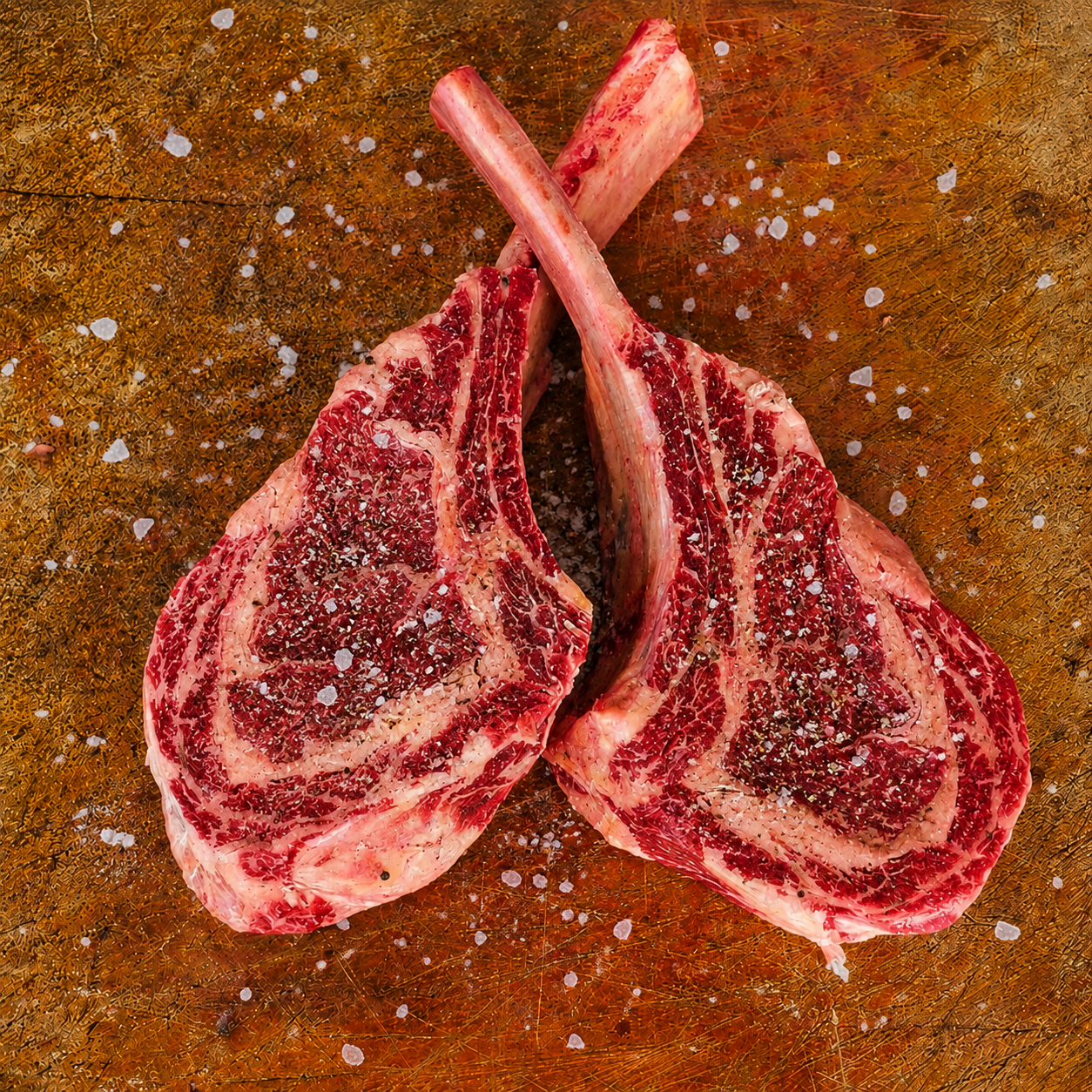
For premium beef such as Japanese Wagyu, Ocean Beef or a beautiful Chianina, we sometimes cook the steak without any salt at all.

These types of beef often have a naturally drier surface, allowing them to develop an outstanding crust during cooking.

Only after the steak has rested do we finish it with freshly cracked black pepper and coarse sea salt from the mill.

Why?

Because it creates an entirely different tasting experience.

When you salt before cooking, part of the seasoning penetrates the meat, creating a beautifully integrated flavour.

But when you season after cooking, you first experience the pure flavour of the beef itself.

Only afterwards do you notice the crunch of the sea salt crystals and the freshness of the black pepper.

It's almost like tasting two separate layers of flavour, perfectly complementing one another.

For certain exceptional cuts, we actually prefer this method.


Our Advice: Try Both Methods

There is no universal rule.

Cook two identical steaks.

  • Season the first one with salt just before cooking.
  • Season the second one only after cooking with coarse sea salt and freshly ground black pepper.

Use exactly the same cut of beef.

You'll be amazed by the difference.

You may even discover a completely new personal preference.


How We Do It at Gustor

At Gustor, we never start with rigid rules.

We always start with the meat.

Every cut has its own unique character.

And not every steak deserves exactly the same approach.

For most steaks, we recommend:

  • Pat the meat dry.
  • Salt just before cooking or at least one hour beforehand.
  • Cook over high heat.
  • Let the steak rest for a few minutes.
  • Finish with freshly ground black pepper.

For some exceptional cuts, we also add the salt only after cooking to preserve the pure flavour of the beef as much as possible.


The Science Behind Salting Meat

For those interested in the science, here's what's happening.

When salt is sprinkled on meat, the salt concentration becomes higher on the surface than inside the muscle.

Through osmosis, some of the water temporarily moves towards the surface.

Over time, the salt dissolves into this moisture, and sodium and chloride ions gradually diffuse throughout the muscle fibres.

At the same time, these ions alter the structure of certain muscle proteins, particularly myosin.

These proteins partially unfold (protein unfolding), allowing them to retain more water during cooking.

Scientists refer to this as an increase in Water Holding Capacity (WHC).

This is precisely why a properly salted steak ultimately loses less moisture during cooking than many people believe.


Conclusion: When Should You Season a Steak?

There isn't one universal answer.

For most steaks, there are two excellent options:

  • just before cooking, or
  • at least one hour before cooking.

However, with exceptional premium beef, seasoning after cooking can sometimes produce an even more refined result.

This allows you to experience the pure flavour of the meat first, followed by the crunch of sea salt and the aroma of freshly ground pepper.


Our Philosophy

At Gustor, we don't believe in fixed rules.

We believe in the right technique for the right cut of meat.

Because in the end, only one rule really matters:

Exceptional beef doesn't need to be hidden beneath a mountain of seasoning. The finest flavour is already in the meat itself.


Frequently Asked Questions (FAQ)


Should you season a steak before or after cooking?

For most steaks, salting just before cooking or at least one hour in advance produces the best results. For exceptional premium beef, many chefs prefer seasoning after cooking.

Does salt dry out a steak?

No. Salt temporarily draws moisture to the surface but ultimately helps the meat retain more moisture during cooking.

Why should pepper be added after cooking?

The aromatic oils in black pepper can burn at very high temperatures, creating a bitter taste.

Why do some chefs season only after cooking?

Because this allows you to taste the pure flavour of the beef first. The salt and pepper then create a second layer of flavour, which is especially appreciated with premium-quality beef.



  • Delivery

    Gustor Meat Boutique delivers delicious fresh meat at home, at work, or on holiday.
    (Benelux and France)

    ATTENTION PLEASE:DURING THE END OF YEAR PERIOD, OTHER THAN NORMAL DELIVERY DAYS AND DELIVERY TIMES APPLY. PLEASE SEE OUR INSPIRATION PAGE)

    Ordered before 9 a.m., delivered before 8 p.m. the next day. If you did not choose a time block option, your order will be delivered as standard between 8 am and 8 pm. For this we enter into a contract with Dynalogic of DHL to deliver between 8 am and 6 pm. After all, we know that the driver is sometimes delayed during the day. The expected time of delivery that you receive from the courier service is therefore never an absolute certainty. How should you interpret the time blocks? Not as an absolute certainty. The morning delivery time block will certainly guarantee that you can serve the meat for dinner, but not that we can guarantee you an appointment at 1.15 pm away from home. In most cases this will work, but it is not a certainty, anything can happen along the way. Afternoon delivery guarantees that you do not need to be home until 1 pm. We deliver from Tuesday to Saturday, but you can always order.

    You can follow the order via a track & trace code, which arrives in your mailbox one day before delivery. The Gustor package is sent under guarantee via Dynalogic or DHL. Don't be alarmed if you receive a message from our DYNALOGIC courier service a few days prior to your delivery. This does not mean that your order has already been shipped, but that we have already reserved a window on their routes for your package for the day in question. Courier services are sometimes overcrowded and in this way we ensure a good delivery. On the day preceding your delivery, you will receive an email from us informing you that your order will be cut, packed and shipped. IMPORTANT: For legal reasons, our courier is forbidden to leave perishable foodstuffs such as meat unattended. You haven't bought a book or a pack of washing powder. Our couriers do their utmost to get your order delivered effectively, but then we also need your cooperation. Should you suddenly go away urgently, place a clear message at your door, addressed to Dynalogic (not to Gustor), stating which neighbor they are allowed to deliver the package to. Without this message, they are legally (food safety) not allowed to deliver the package to a neighbor. And please call us in this case, so we can inform the driver before delivery

    As a customer, it is not permitted to change your delivery appointment with the courier service yourself. Changes must always be made via Gustor. Your own agreements with the courier service are outside the responsibility of Gustor

    It is important to know that we always send fresh and chilled and never frozen - unless otherwise stated on the website. Thanks to the refrigerated packaging, we can guarantee our customers an optimal taste experience. The meat therefore remains refrigerated after delivery! Ideal for those who deliver at the reception of the office or workshop.

    If the meat is not delivered in excellent condition, the customer gets his money back. That is the Gustor guarantee.

  • Pickup

    Gustor Meat Boutique also has a Pick-Up store in Koksijde, where orders can be picked up for free.

    The address of the Pick-Upstore is Zeelaan 205, Koksijde. Open from Monday to Friday, 10 a.m. to 12 noon.

Didn’t receive a confirmation email? Be sure to check your spam box! The mail with the track & trace code can also be found there.

Would you rather have had your meat on the day itself? Call us: +32 473 60 06 22

When stored under 6 ° C, the vacuum packaging guarantees a total freshness of 8 days after reception. For poultry this is four days with a storage under 4 ° C.

In the freezer you can keep the meat for up to six months.

All products are shipped fresh - and therefore not frozen - unless stated otherwise on the website. No product was previously frozen.

A special announcement about smell, color and taste. Gustor Meat Boutique products are top products, usually matured and always full of flavor. If you have no experience with such products, you will undoubtedly notice that our products usually have a specific smell. Also, the slightly browner, matured color is different from the meat that you find in the supermarket.

This is completely normal. For example, an odorless wine cannot possibly be a top wine, and the color evolves as the wine ripens longer.

Because we work with fresh products, it is possible that a product is no longer available. Keep an eye on the website or email us to see when something is available again.

Delicious (and) fresh meat guaranteed, thanks to a combination of cooling and insulation.

The meat is cut to size as desired. Ordered multiple items? These are first individually vacuum packed, so hygiene and safety remain guaranteed. The packaged meat then goes into an insulating EPS (polystyrene) box, which keeps the meat in excellent condition during shipping.

At Gustor Meat Boutique we attach great importance to the environment. The packaging was specially designed by us and is environmentally friendly. The enclosed cooling elements are perfectly reusable and have been certified by an independent inspection body: non-toxic and suitable for cooling foodstuffs - in full compliance with the rules of the FASFC. If you still want to discard the box, it is good to know that EPS is perfectly recyclable.

Our meat is never sent frozen, unless otherwise stated on the website.

In order to guarantee our customers an optimal taste experience with our exceptional quality meats, we always deliver fresh and chilled products.

If the meat is not delivered in optimal conditions, the customer is reimbursed. This is the Gustor guarantee.

Transportation Costs for cooled delivery

Order total : < 150 € > 150 € > 300 €
Belgium, Netherlands & Luxemburg 10,89 € Free Free
to France 25 € 25 € Free
to Germany 25 € 25 € Free
Pick-up Free at our Pick-Up store in Koksijde is free (select pick-up next step)

All weights on the website of Gustor Meat Boutique are global weights that make a payment in advance possible. The actual weight of the meat can differ, because the order is in its total weighted.

Gustor Meat Boutique guarantees that the difference between the two will never be greater than 5%. If the delivered weight proves to be more than the originally given weight, the customer obviously does not have to pay.

Should the difference still be greater than 5%, Gustor Meat Boutique provides a refund in cash.

The difference between the two weights is calculated with a subtraction sum and then multiplied by the average price per kilo of the purchased goods.

La race n’est pas le seul paramètre essentiel dans la qualité d’une viande. Le ‘terroir’ - le milieu dans lequel l’animal a vécu - et la nourriture qu’il a reçue sont autant d'éléments cruciaux. Les Highlands écossais, les Alpes autrichiennes, les forêts des Landes sont autant d’environnements qui garantissent une plus-value dans la qualité de la viande. Nous sommes constamment à la recherche de ces viandes provenant de ces régions d’exception. Il est évident qu’une viande de vache Holstein qui a passé des années dans un élevage laitier aux Pays-Bas n’a rien en commun avec celle du même type d’animal qui s'est nourri dans les herbages des Alpes autrichiennes.

Vous recevrez un couriel de confirmation immédiatement après votre commande. Dès cet instant, l’adresse de livraison ne peut plus être modifiée. Nous tenons ainsi éviter tout risque de confusion qui entraîneait un retard de plusieurs jours.

Quelques astuces pour une livraison parfaite? Cliquez ici...


Customer Service

Customer service can be reached every weekday of the week from 8 am till 6 pm.

In case you still have any questions or you would like some assitance making your order, don't hesitate to contact us.